
Understanding Calibration CSV Reports
Frequency Calibration Results
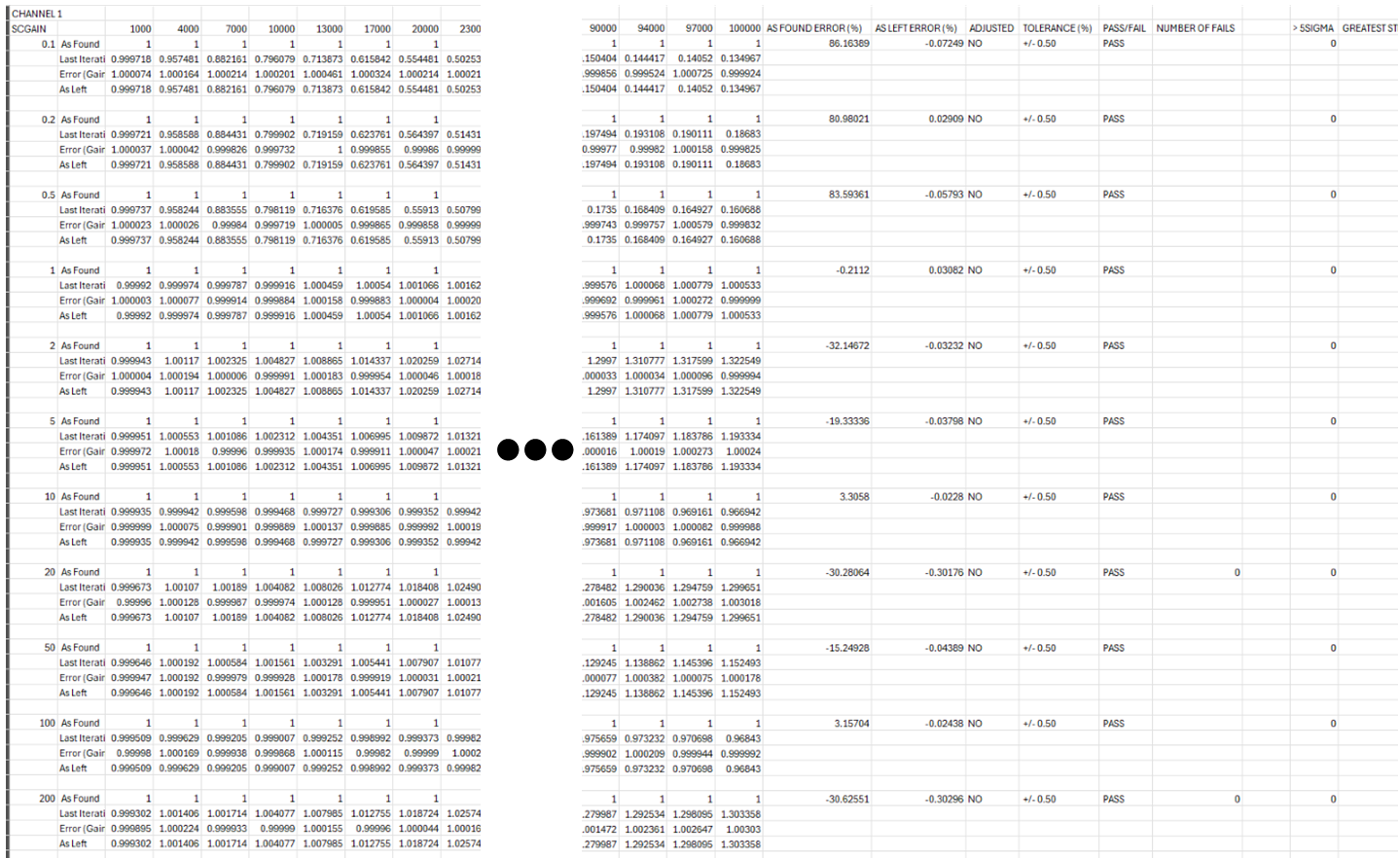
The calibration results are organized by channel, then each channel is broken up by gain. At the top of each channel shows the frequency calibration points (1,000hz, 4,000hz, 7,000hz, ....100,000hz). For each gain we display the following rows.
- As Found - This is the current gain setting measured at that frequency point before any calibration adjustments reflecting the units "as found" condition.
- Last Iteration - This is the gain value from the most recent calibration pass (the previous iteration).
- Error (Gain) - This is the current gain error, expressed as a decimal. To read it as a percentage:
- 1.000074 = +0.0074% error
- 0.99977= -0.023% error
- As Left - This is the gain setting left on the unit for that frequency point after calibration.
At the end of each row we can see a summary for each gain with the following columns.
- As Found Error(%) - The highest error value from the very first calibration pass from all the frequency points.
- As Left Error(%) - The final highest error value after calibration is complete from all the frequency points.
- Adjusted - Indicates whether the software made an adjustment after the last pass.
- Tolerance (%) - The allowable error range for pass/fail evaluation. This setting is currently not adjustable and is held to a tighter tolerance than is needed to perform the best calibration it can, we often use +/- 1% as a pass/fail criteria.
- Pass/Fail - Final result checking the As Left Error(%) meets the criteria of the tolerance for a Pass
- Number of fails - Indicates the number of frequency points for the channel and gain that were above the tolerance. These are summarized at the bottom of the csv
- The remaining columns are primarily used by our main calibration system that can compare trends over similar units, not all units support this currently.
We design our calibration limits to be very conservative so we can catch even the smallest deviations. This ensures maximum accuracy across the entire bandwidth of the system. We find +/- 1% to be more than sufficient especially if general trends of the Standard Frequency Gain plots are consistent.
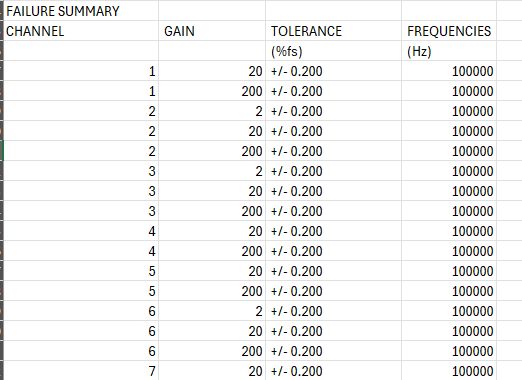
Whether a failure is truly meaningful depends on your intended operating frequency range as well. for example if a channel "fails" at 100 khz but the end goal is to record at 20khz then that failure is not functionally relevant and the unit may still be perfectly acceptable for use.
Users should review any failures in the context of their actual frequency requirements when deciding if a unit truly "passes" or "fails"